
November 17, 2026• byleahk
… & has thoughts about tilted pelvises, spray tans, & lymphatic drainage.
I got married 3 weeks ago and I’m finally getting around to all the reflective writing I want to do on the topic of the wedding.
So far I wrote about getting over my holier-than-thou bride complex.
Now I’m diving into what body image pressure before your wedding can look like, and how I navigated it throughout the event
I shudder to imagine what the months leading up to my wedding would’ve felt like if I was still in the throes of diet culture.
Feverishly googling tips for burning “stubborn belly fat.”
Incessant body checking to monitor progress.
Then would come the wedding day.
Time to show off the “project” I’d been working on perfecting for the last six months.
I’d scramble to hit the hotel gym the morning of. Gotta put the “finishing touches” on.
Then the photos.
Sucking it in, contorting myself to look as thin as possible.
Thoughts about my appearance stealing me away from the present moment.
I can see it all so clearly because I used to live it.
My disordered eating and body image issues are, thankfully, 11+ years in my past.
But I can still access the way I saw the world when I was living in that mentality.
Everything was reduced to numbers.
Good vs. bad.
Failure or success.
Life was dull. I was hangry and anxious and insecure.
I thank my lucky stars that, by the time my wedding rolled around, those days were so far in the rearview mirror.
On the day of my wedding, being in my body felt peaceful and easy.
I attribute this to years of deep, internal work on my relationship with food and body (plus a sprinkle of Zoloft).
That’s not to say the siren call of diet culture didn’t get louder in the months leading up to the wedding.
Or that I didn’t occasionally act on the pressure to look a certain way.
But overwhelmingly, I felt peace.
My Foundation (Pre-Engagement)
These days, I feel mostly neutral about my body.
I haven’t weighed myself in years, but based on my pants size, I’m in the biggest body I’ve ever been. And for the most part, I feel acceptance around this.
There are still days when I feel fussy in my body, tearing apart my closet just to find something that feels okay enough to wear to the grocery store.
But the magnitude and frequency of that distress are much lower than when I was engaging in disordered eating.
Old, diety thoughts still creep in.
The repeat offenders tend to be:
You’d look better if you lost your belly.
Or:
Your face is so round. What happened to your jawline?
But the cool thing is, these thoughts rarely turn into actions.
Because, as an anti-diet dietitian, certified intuitive eating counselor, and body image coach of 6 years, I know too much…
I know the risks of pursuing intentional weight loss. I know how much of our body size and shape is determined by genetics. And I know that the pressure to make ourselves smaller is rooted in systems that don’t align with my values.
So when the occasional body dissatisfaction thoughts show up, I mostly just sit with them.
It’s not comfortable.
But I’ve learned that if I ride the wave, it’ll pass. I’ll get over it and move on with my life.
This is what body acceptance looks like for me.
Not loving what I see in the mirror every day, but learning to surf the waves of distressing body image thoughts without attaching my worth to them.
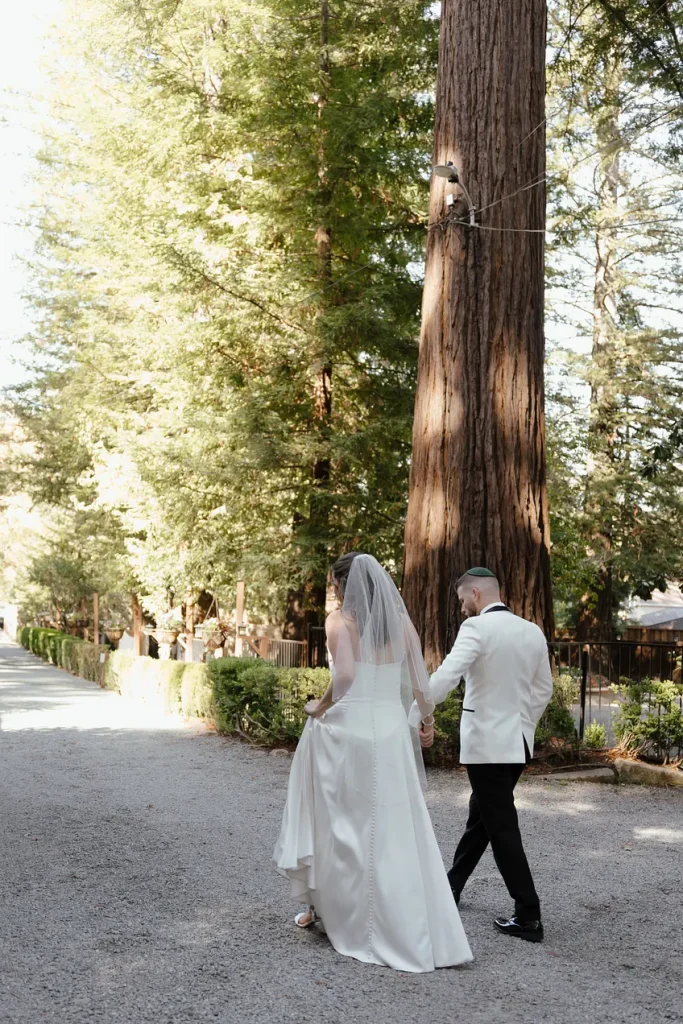
So when it came to my wedding, I knew I had a solid foundation.
I wasn’t going to pursue weight loss in preparation for the big day.
But even with all the tools, experience, and professional training I have under my belt, I still felt the pressure to “look my best.”
Leading Up To The Wedding
As the wedding got closer, I started noticing myself zero in on parts of my body that I hadn’t previously given much thought.
Did I always have these deep lines between my eyebrows?
I wonder if I can get rid of these red textured bumps on the back of my arms.
Do I have anterior pelvic tilt? (Something I discovered in a late-night YouTube rabbit hole).
Should I be doing some kind of lymphatic drainage to “snatch” my face?
Even though I’m not on social media, I still end up internalizing messaging about the things a woman “should” do in preparation for her wedding.
But as a body image coach, I had the awareness that we often use our bodies as a way to feel a sense of control when things feel out of control.
And as the wedding got closer, things were definitely getting overwhelming.
Its easier to obsess over fine lines than it is to face the big emotions of am impending life event and all the logistics and interpersonal dynamics that come with it.
So instead of
I need to fix my fine lines, jaw line and pelvic tilt(??) to look perfect on my wedding day….
The inner dialogue sounded more like
I’m noticing a sudden surge of critical thoughts about my body. I also know that things are fairly hectic right now. Is it possible that I’m turning to my body as a way to take out my stress and anxiety about this big life event coming up?”
Which turns into
Okay maybe I don’t need to schedule a lymphatic drainage facial. Maybe I just need to do something that helps me relax .
Call a friend.
Go for a walk.
Read my Kindle.
Knowing that the impulse to obsess over my appearance was likely coming from a place of trying to feel control doesn’t fully take away the associated distress.
But the awareness helps to interrupt the automatic thoughts and identify the underlying need.
So all that therapy talk is great, but I’m also human.
Just because I do body image coaching and anti-diet work professionally doesn’t mean I’m the picture of resisting beauty standards and fighting the patriarchy.
Sometimes, I do things that I know come from a place of wanting to more closely meet the beauty standard. And I try not to beat myself up about it.
We all have to live in this image-centric culture. There is an unfortunate reality that people who more closely match up with the conventional beauty standard get more power and privilege.
And its not just about being skinny and having toned arms.
The beauty standard also implies being white, able-bodied, young, and often affluent.
This is fucked.
And, it’s the reality we operate within.
So while I’m trying my best to challenge these standards through my work as a fat-positive, non-diet registered dietitian, I also believe we shouldn’t be so hard on ourselves for the ways we participate in them.
We have to do what we can to feel comfortable— and in some cases safe— in our bodies.
One of my mentors, Brianna Campos, says that we don’t have to perform “sexy body image.” Which means you don’t have to push yourself to wear a bikini if you’re not comfortable. You’re allowed to do the safe thing. To wear the one piece plus the coverup. It’s okay, you’re not failing at body acceptance.
The point of this work is to be able to be present in your life instead of self-objectifying, constantly thinking about how you look while living your life.
If wearing the two piece and coverup is what gets you to go to the pool party and not think about your body the whole time, that’s a win.
Plus, holding ourselves to the standard of being “perfect” at body acceptance work is embodying the same energy as diet culture (all-or-nothing thinking, perfectionism).
We can be actively working to dismantle these oppressive standards while also engaging in some of them from a place of doing what we can to make ourselves comfortable.
For me, there are certain beauty standards I’m willing to engage with and others where the cost feels too high.
I will not pursue changing my body size because of what I know about the risks of weight cycling, developing (or relapsing into) an eating disorder, and being under-fueled.
But, something like using teeth whitening strips, feels more benign.
Again, thats not to say I didn’t have any urges to try and lose weight or “tone” my body…
It’s just that when these urges came, I talked to myself like I’d talk to a friend.
Aww buddy, you’re noticing thoughts about wanting to lose weight? Yeah, that’s so normal. Especially with your wedding coming up and with the extra loud diet culture noise that comes with wedding culture. It’s okay to have those thoughts. And it’s okay to be less than thrilled with certain parts of your body. You’re human.
So I let myself get a spray tan.
I purchased a large pack of Crest White Strips from Costco (except after the second one, my teeth were so sensitive I swore them off. Not worth it, ouch!!)
I panic bought a box of expensive pimple patches at Target the week of the wedding because my forehead was breaking out
I even got a facial where the women told me she was “sculpting” my face from lymphatic drainage (I noticed no difference).
I did these things knowing they might provide some sense of comfort or make me feel marginally better.
But at this point in the body acceptance game, I know these topical things aren’t the big needle movers.
The really impactful stuff is, unfortunately, so much less glamorous:
Values work
Learning your intrinsic gifts
Dismantling your own internalized weight-stigma.
Challenging diet culture.
All things that have nothing to do with how well you can “snatch” your jawline.
The Friday Night
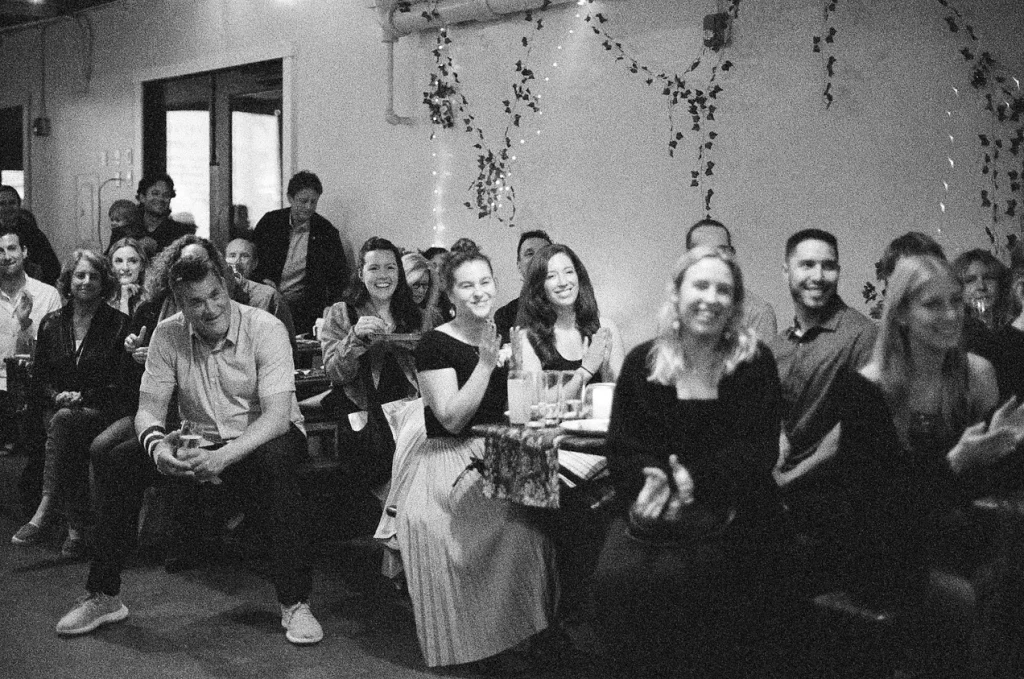
We had 125 wedding guests and ~100 of them were traveling in from the east coast for the wedding. So, on Friday we hosted a casual welcome event at a brewery.
My outfit that night required boob tape in place of a bra because of the neckline.
Wearing something with a deep plunge made me more aware of my body, but not in the diet culture sense of:
Is my stomach sticking out?
More in the way of:
Is this boob tape showing?
Which was less distressing but still not ideal, because it pulled some of my attention away from being present and diverted it toward thinking about how I looked.
Eventually, I surrendered and was just like, whatever, if you see the tape, you see the tape.
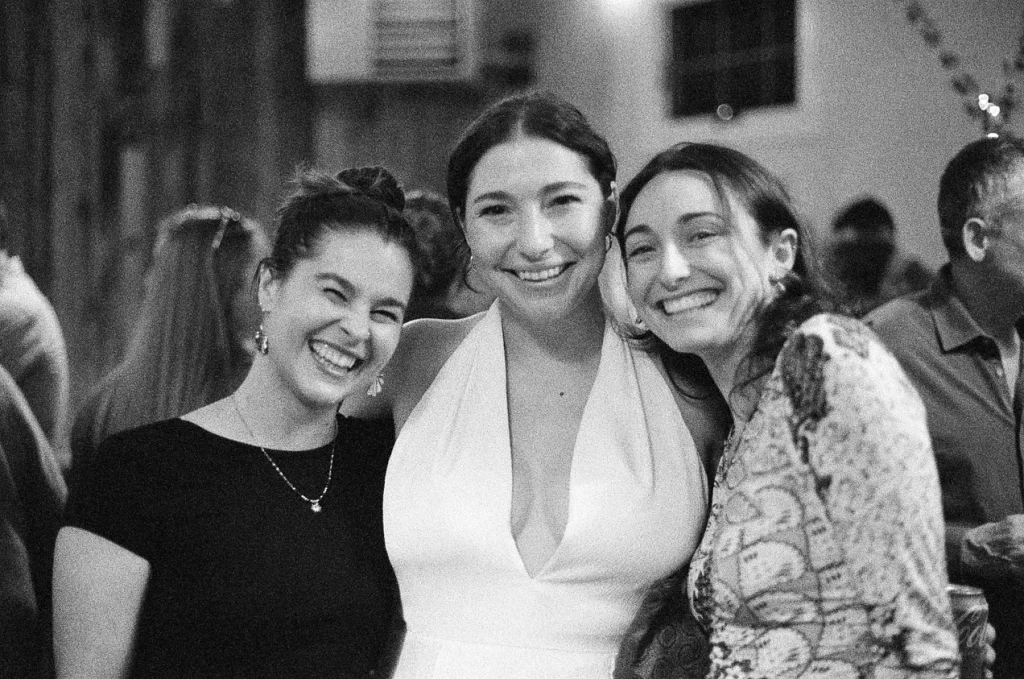
I’m not used to showing cleavage, so that was kind of a body image thing to get over.
The jumpsuit felt very “me,” which helped offset how out of character it felt to have my cleavage on display.
Wedding Day
Al and I didn’t do the thing where we stay separate on the morning of the wedding.
And this wasn’t me trying to be not like other girls…
It’s just that, the way my anxious brain is wired, I can do without the dramatic buildup.
I didn’t work out or do any kind of physical activity the morning of my wedding.
My attitude was very much: My body is my body, and nothing I do this morning is going to change the way I look.
Plus, I personally didn’t want to spend precious time on my wedding morning in the gym.
There is a world in which a run or walk or hike would’ve felt nice for my mental health, getting my mind right, getting some “ya ya’s” out, as Al and I call it.
But there wasn’t time, and sleep was my priority.
Before working on my relationship with food and body, you wouldn’t have caught me dead missing a workout on the morning of my wedding.
And it would not have been from a place of “getting my mind right.”
(Though I would’ve said that’s what it was about.)
It would’ve really been about putting the “finishing touches” on my body before the big day.
When my friend Jamie finished my hair and makeup and I put the dress on, I felt good.
But more importantly, I felt like myself.
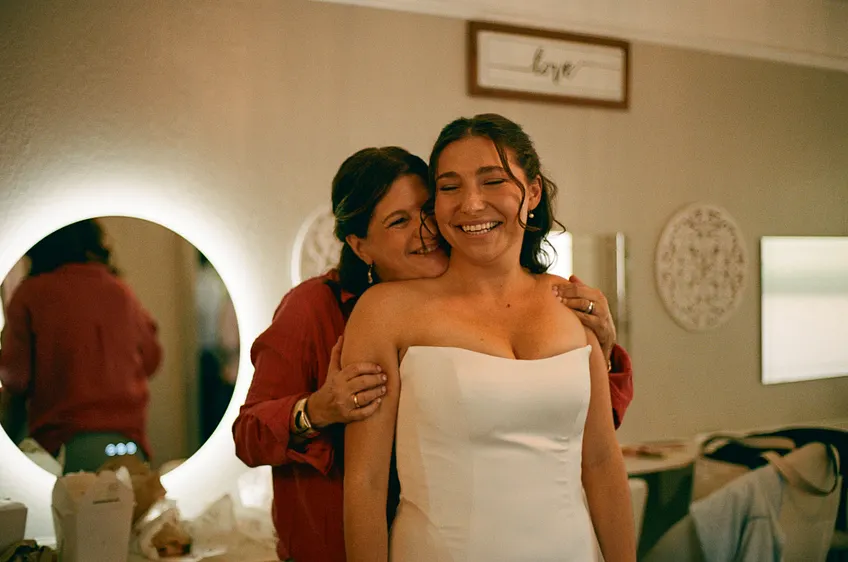
I’ve learned over the years that I get spooked if, when dressing up, I look drastically different from my everyday look.
It’s almost like how my cat Ruthie hissed at her brother, Murray, when he came home from the hospital in a cone.
She didn’t recognize his outline and was alarmed!
If I don’t “recognize my own outline,” I feel disoriented. Even if I think I objectively look “good,” I won’t feel settled in myself if I don’t feel like I look like me.
In an effort not to “spook” myself, I decided to wear my natural curls instead of having a sleek blowout.
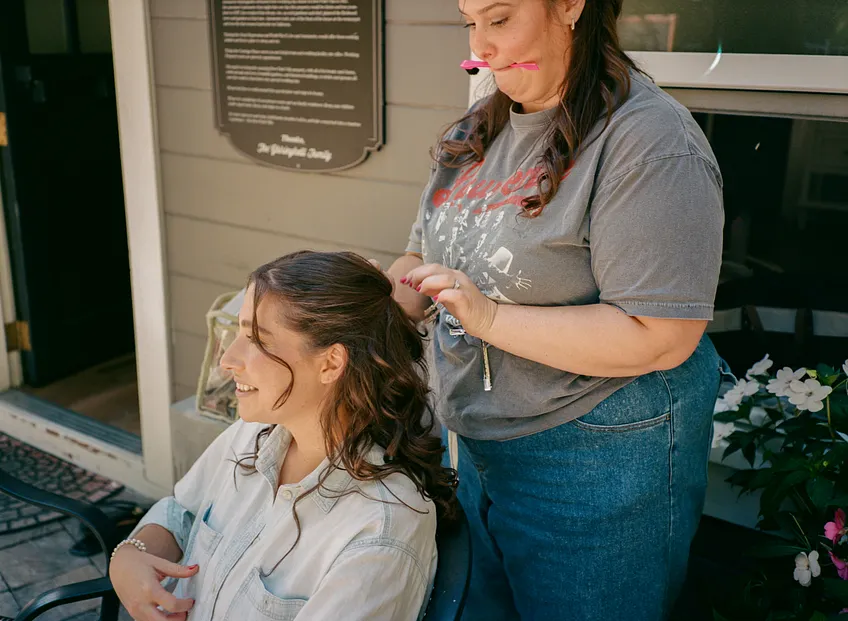
My friend just went in with a curling iron and touched up any wonky pieces, following my natural curl pattern.
This helped me feel like me in a big way.
When close pals started arriving and asking how I felt, I found myself saying:
“I feel good. I feel like myself!”
First Look & Pictures
(Casual in the sense that we’d already seen each other that day).
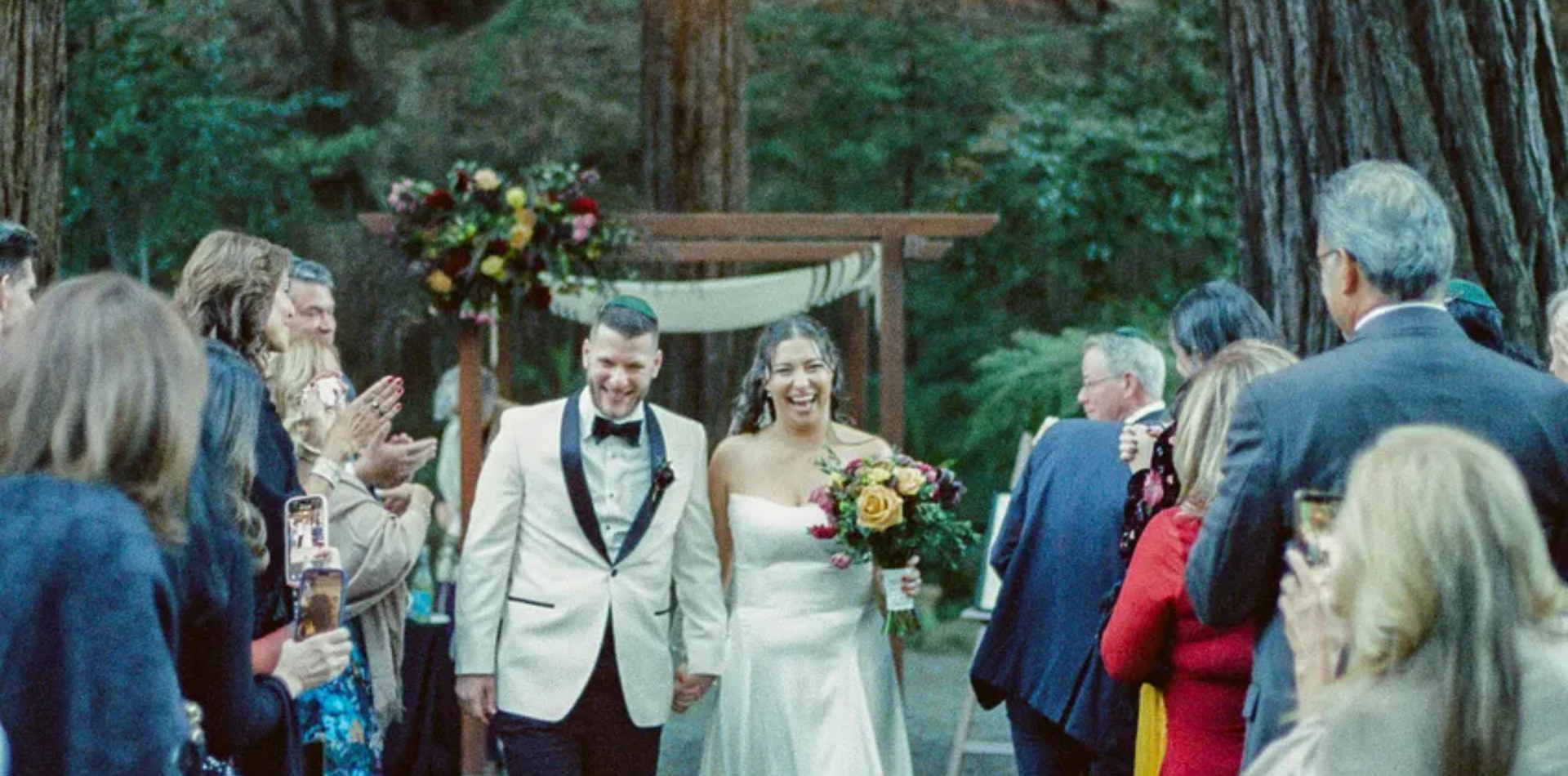
In the first look pics— and many of the other pics from the night— I have a giant, open mouth smile.
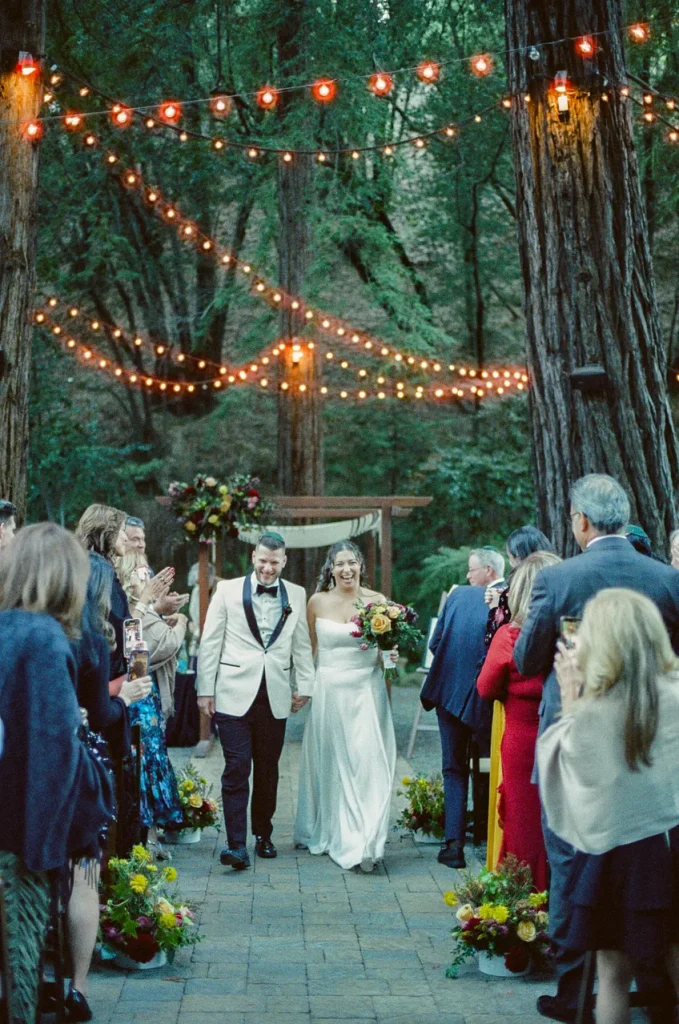
There’s nothing coy about it, but I know no other way.
I only saw one photo of myself that a friend showed me on the day of the wedding. The rest I didn’t see until the day after.
I prefer it this way.
I find that looking at pictures in the moment can lead to being hypercritical, whereas having some space from the experience often makes it less activating.
In their book More Than a Body, Lexie and Lindsay Kite write about self-objectification, the experience of watching and evaluating ourselves from the outside instead of fully inhabiting our lives.
“Self-objectification occurs when people learn to view their own bodies from an outside perspective, which is a natural result of living in an environment where bodies are objectified….
When we are self-objectifying, our identities are split in two: the one living her life and the one watching and judging her. We become our very own self-conscious identical twin, an onlooker to ourselves, monitoring how we look rather than how we are feeling or what we are doing.”
Throughout the night, I was really able to be in my body.
I wasn’t constantly monitoring how I looked.
I was just there, living it.
And that was only possible because of the years I’ve spent unlearning the habit of self-objectifying.
Getting The Photo Album
As I clicked through the preview album from the photographer, I noticed some initial critical thoughts.
Pictures can be hard.
I hear from clients all the time things like:
Seeing the photo of myself was so jarring. I had fun and felt good in the moment but when I saw pictures I was like “oh god I looked like THAT?!”
But I’ve had enough experience with this sort of thing—seeing my business brand photos, engagement photoshoot, etc.—to know not to fully trust my first impression of a picture.
I know how easy it is to look at a photo and immediately start picking apart your appearance.
And with wedding photos, there’s this added pressure. These are the pictures you’ll have forever to commemorate the milestone. You really want to like them.
But as I kept swipping through the album, what struck me most wasn’t how my body looked.
It wasn’t my jawline.
Forehead lines.
Textured skin.
Or my self-diagnosed anteriorly tilted pelvis.
It was how happy I looked.
How comfortable I seemed in my skin.
How sweet Al and I were together.
How much I looked like me.
I saw the giant smile. The curls. The person who had spent the weekend laughing and connecting and being fully there.
And I felt so grateful that I’d actually gotten to experience the wedding that way.
Note: I recognize that while I experience occasional body image struggles, I also hold many privileges that protect me from forms of systemic discrimination and mistreatment. I’m white, straight-sized, and cisgender, among other privileged identities. I recognize that not everyone has the same experience of moving through the world in their body. A central part of my life’s work is challenging weight stigma and advocating for a more equitable world for people of all body sizes and identities.
If you’d like more content on the topic of body image and divesting from diet culture, subscribe to my newsletter here.


